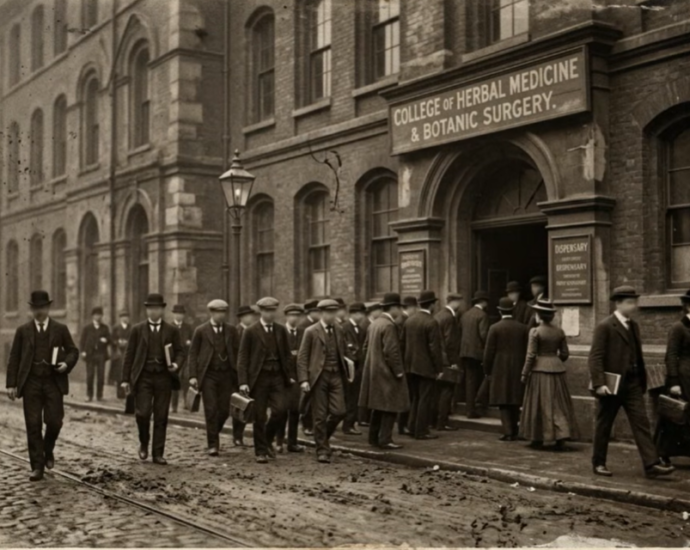
In 1913 the Rockefellers Bought Every Herbal School in America — Then Closed Them All by 1925
In 1910, America had 165 medical schools, homeopathic schools, naturopathic schools, eclectic medicine schools that taught botanical remedies your grandmother would recognize, herbal colleges that had been training doctors for generations. By 1925, only 81 remained, and not one of them taught herbal medicine anymore. What happened in those 15 years wasn’t a natural evolution of science. It wasn’t doctors choosing better methods. It was a coordinated takeover orchestrated by one family with enough money to rewrite the rules of medicine itself. The Rockefellers didn’t just fund medical schools,
00:41
they bought them. They didn’t just promote pharmaceutical medicine, they systematically destroyed every alternative. And they didn’t do it because the science demanded it, they did it because there was no profit in plants you could grow in your backyard. This is the story of how American medicine became a monopoly, how botanical knowledge that had survived for centuries vanished in a single generation, and how the wealthiest family in America used philanthropy as a weapon to control what doctors could and couldn’t learn. If this sounds like the kind of history they don’t teach in schools, you’re in the right place.
01:16
Hit subscribe because we’re about to pull back the curtain on one of the most successful corporate takeovers in American history, one that still shapes every prescription you fill today. Before 1900, American medicine looked nothing like it does today. There was no FDA, no standardized medical training, no pharmaceutical giants controlling prescriptions, and certainly no agreement on what medicine actually was. Medical schools operated on completely different philosophies. Regular medicine, which focused on aggressive interventions like bloodletting and mercury treatments, homeopathic medicine,
01:53
which used highly diluted substances, eclectic medicine, which combined conventional treatments with botanical remedies, naturopathy, which emphasized the body’s natural healing capacity, and dozens of smaller schools teaching everything from chiropractic to osteopathy. None of them had a monopoly. Patients chose their doctors based on results, not credentials. If your family doctor couldn’t cure your pneumonia with his methods, you’d visit the herbalist down the street. If the regular physician’s treatments made you sicker, you’d try the homeopath. Competition forced every school of medicine to actually produce results or lose patients.
02:31
The herbal schools were particularly successful. Schools like the Physio-Medical College of Indiana, the Eclectic Medical Institute in Cincinnati, and the National College of Naturopathic Medicine in Portland were graduating hundreds of doctors every year. These weren’t fringe operations. They had decades of history, legitimate training programs, and patient outcomes that rivaled or exceeded conventional medicine. Botanical medicine had been the foundation of health care for thousands of years. Willow bark for pain, which we now know contains the compound that became aspirin,
03:09
foxglove for heart conditions, the source of digitalis, cinchona bark for malaria, which gave us quinine. These weren’t folk remedies, they were medicines that worked, backed by generations of documented use. But botanical medicine had one fatal flaw from a business perspective. You couldn’t patent a plant. Anyone could grow willow bark. Anyone could harvest foxglove. There was no way to create a monopoly on knowledge that had been public domain for centuries. John D. Rockefeller understood this better than anyone. The call to adventure. By 1900, Rockefeller had already become the richest man in America through Standard Oil.
03:51
He’d perfected the art of the monopoly, undercut competitors until they went bankrupt, then buy their assets for pennies on the dollar. Control the supply chain from extraction to distribution, eliminate every alternative until customers had no choice but to buy from you. He’d done it with oil, now he wanted to do it with medicine. But there was a problem. Medicine wasn’t like oil. You couldn’t just drill for it and control the wells. Medical knowledge was distributed across hundreds of schools, thousands of practitioners, millions of patients who trusted remedies passed down through families.
04:27
Rockefeller needed a different strategy. He needed to control not the medicine itself, but the people who decided what counted as medicine. He needed to control medical education. In 1901, Rockefeller founded the Rockefeller Institute for Medical Research. The public story was philanthropy, a wealthy man giving back to society by funding scientific advancement. The private reality was the first move in a calculated takeover. The institute didn’t just fund research, it funded very specific research, studies on synthetic compounds that could be patented, laboratory science that required expensive equipment only large institutions could afford.
05:10
Drug development that would create dependencies on pharmaceutical companies. Rockefeller brought in Frederick T. Gates, a former Baptist minister turned business advisor, to run the operation. Gates understood that controlling medicine meant controlling the gatekeepers, the medical schools that trained doctors, the licensing boards that decided who could practice, the journals that determined what counted as legitimate science. Gates laid out the strategy in a confidential memo to Rockefeller. They would use philanthropy to gain influence over medical education, fund the schools that taught pharmaceutical medicine,
05:46
starve the schools that didn’t, and most importantly, create a standardization system that would eliminate competitors under the guise of raising quality. The plan required credibility. They couldn’t just declare that herbal schools were inferior. They needed someone respectable to make that case for them, someone the medical establishment would trust. They found their man in Abraham Flexner. The mentor and crossing the threshold. Abraham Flexner was not a doctor. He’d never practiced medicine, never attended medical school. He was an educator who ran a private school in Louisville and had written a book criticizing American colleges.
06:28
That book caught the attention of the Carnegie Foundation, which was working closely with Rockefeller on the medical education project. In 1908, they hired Flexner to conduct a comprehensive survey of every medical school in America. The Carnegie Foundation would fund the study. Flexner would visit the schools and write the report, and the Rockefeller Institute would implement the recommendations. On the surface, it was a noble goal, evaluate the quality of medical education and help improve standards. But the criteria Flexner used weren’t neutral. They were specifically designed to favor one type of medicine over all others.
07:09
Flexner’s standards required expensive laboratory facilities, full-time faculty with research credentials, extensive clinical training in hospital settings, standardized curricula based on European models, high entrance requirements that would limit enrollment. These standards made perfect sense for pharmaceutical medicine, which was laboratory based, required expensive equipment, and relied on hospital access. They made no sense for botanical medicine, which was practice based, required gardens and field knowledge, and had successfully trained doctors in apprenticeship models for centuries.
07:49
Herbal schools couldn’t meet Flexner’s standards without abandoning everything that made them effective. They’d have to eliminate their gardens and replace them with laboratories, fire their experienced practitioners and hire research Ph.D.s, stop teaching patients how to grow their own remedies, and start teaching them to prescribe patented drugs. It was a setup. The standards weren’t designed to measure quality. They were designed to eliminate competition. Flexner spent 2 years visiting 155 medical schools across America. He gave most of them less than a day. Some got only a few hours.
08:27
He didn’t evaluate patient outcomes, didn’t interview graduates, didn’t review long-term success rates. He measured buildings, equipment, and whether schools matched his predetermined criteria. In 1910, the Flexner report was published. It was a devastating attack on more than half of America’s medical schools. Schools that had operated successfully for decades were declared inadequate overnight. Herbal schools, homeopathic schools, naturopathic schools were all condemned as unscientific, poorly equipped, and dangerous to public health. The report recommended that most of them be closed immediately.
09:02
The tests, allies, and enemies. The Flexner report wasn’t just an academic document, it was a weapon, and Rockefeller knew exactly how to use it. Within months of publication, Rockefeller’s General Education Board began offering unprecedented grants to medical schools, but only to schools that agreed to implement Flexner’s recommendations, only to schools that would restructure their curricula around pharmaceutical medicine, only to schools that would abandon botanical and alternative approaches. The money was staggering. Washington University in St. Louis received $75,000 in 1910,
09:41
equivalent to over $2 million today. Johns Hopkins got even more. Yale, Harvard, Columbia all received massive Rockefeller grants, but only after agreeing to drop their homeopathic departments and restructure around pharmaceutical training. Schools that refused the money found themselves in an impossible position. State licensing boards, influenced by the Flexner report, began requiring graduates to come from accredited schools. But accreditation required meeting Flexner standards, which required money most schools didn’t have. The Eclectic Medical Institute in Cincinnati had been training doctors since 1830.
10:21
80 years of successful graduates, thousands of practitioners, a solid reputation for producing effective physicians. When they refused to abandon botanical medicine, Rockefeller’s foundation refused funding. When they couldn’t afford to build the laboratory facilities Flexner demanded, they lost accreditation. When they lost accreditation, they couldn’t legally graduate doctors. By 1939, they were forced to close. The pattern repeated across the country. The Physio-Medical College of Indiana, the California Eclectic Medical College, the National College of Naturopathy, the American School of Naturopathy.
11:00
All destroyed, not because they were producing bad doctors, but because they couldn’t afford to meet standards specifically designed to exclude them. Some schools tried to adapt. The New York Homeopathic Medical College attempted to incorporate Flexner’s recommendations while maintaining their homeopathic focus. They built laboratories, hired research faculty, restructured their curriculum. It didn’t matter. Rockefeller’s foundations still denied them funding. By 1918, they’d merged with a conventional medical school and abandoned homeopathy entirely. Hahnemann Medical College in Philadelphia,
11:38
one of the most prestigious homeopathic institutions in America, held out longer. But without funding, they couldn’t compete. Their facilities aged while Rockefeller backed schools built modern campuses. Their faculty left for better paying positions at pharmaceutical schools. By 1950, they’d eliminated homeopathic training. The last major Eclectic Medical School, the Eclectic Medical University in Kansas City, fought until 1939. They graduated doctors who would practice botanical medicine into the 1960s, but they couldn’t train new ones. The knowledge began dying with that generation.
12:19
What made this particularly insidious was the public relations campaign that accompanied it. Rockefeller’s foundations didn’t present this as an attack on competition. They framed it as raising standards, protecting patients, advancing science. Anyone who objected was painted as anti-progress, anti-science, a snake oil salesman protecting their scam. But the science didn’t support the attack. Botanical medicines weren’t less effective than early pharmaceutical drugs. Many early pharmaceuticals were just isolated compounds from the same plants herbalists had been using for centuries.
12:54
The only difference was that pharmaceutical companies could patent the isolated compound and charge monopoly prices. The approach to the inmost cave. By 1920, the takeover was nearly complete, but Rockefeller faced one remaining obstacle. The doctors already in practice. Tens of thousands of herbalists, homeopaths, naturopaths, and eclectic physicians were still treating patients across America. They’d been trained before the Flexner report. They had established practices, loyal patients, and decades of experience. You couldn’t just shut them down. So, Rockefeller’s foundations took a different approach.
13:35
They went after the licensing boards. Every state had a medical licensing board that decided who could legally practice medicine. Before 1910, most boards were fairly open. If you graduated from any legitimate medical school and could demonstrate competence, you could get licensed. Different philosophies of medicine coexisted under the one regulatory framework. The Flexner report changed that. It recommended that licensing boards only recognize graduates from accredited schools. And accreditation would only go to schools meeting Flexner standards, schools teaching pharmaceutical medicine.
14:11
Rockefeller’s foundations funded campaigns to convince state legislatures to adopt these new licensing requirements. They provided model legislation, funded lobbying efforts, even directly funded the salaries of board members who supported their position. State by state, the licensing requirements changed. New York in 1915, California in 1917, Illinois in 1921. Each state adopted regulations that effectively made it legal to practice botanical medicine, even if you’d been successfully doing it for 30 years. Doctors who’d been licensed under the old system were grandfathered in,
14:45
but they couldn’t train new apprentices, couldn’t pass their knowledge to the next generation. When they retired or died, their approach to medicine died with them. The older physicians fought back. They filed lawsuits arguing that the new licensing laws violated their rights to practice. They organized professional associations to lobby state legislatures. They published journals documenting their patient outcomes, trying to prove that their methods were just as effective as pharmaceutical approaches. It didn’t matter. Rockefeller’s foundations had unlimited money for legal battles.
15:19
They funded counter lobbying campaigns. They placed favorable articles in major newspapers. They provided grants to universities that would produce studies showing pharmaceutical superiority. The systematic destruction of botanical medicine wasn’t happening in the dark. It was happening in full view, presented as progress. Medical journals that took Rockefeller advertising money published editorials attacking herbal medicine as primitive and dangerous. Newspapers that depended on pharmaceutical advertising ran stories about quacks and con artists, lumping legitimate herbalists in with actual frauds.
15:56
The American Medical Association, which had been reorganized and funded with Rockefeller money, launched its own campaign. They created a propaganda department in 1906, later renamed the Bureau of Investigation. Its explicit purpose was to attack alternative medicine and anyone who practiced it. The AMA’s investigator, Arthur J. Cramp, spent decades writing exposés of homeopaths, naturopaths, chiropractors, and herbalists. His work was published in JAMA, the Journal of the American Medical Association, and reprinted in newspapers across the country. The message was consistent.
16:33
Pharmaceutical medicine was scientific and trustworthy. Everything else was quackery. What Cramp never mentioned in his exposés was that the AMA was receiving massive funding from pharmaceutical companies and Rockefeller foundations. The organization wasn’t an independent medical authority. It was a lobbying arm of the industry it claimed to regulate. The supreme ordeal. The final blow came in the form of the Shepherd-Towner Act of 1921. On its surface, this was a maternal and child health law providing federal funding for prenatal care and infant health programs. Noble goals that few could argue against,
17:13
but buried in the implementation was a requirement that federal health funding could only go to programs staffed by doctors from accredited medical schools. Schools that met Flexner standards, schools that taught pharmaceutical medicine exclusively. Midwives who had been delivering babies safely for generations found themselves ineligible for federal programs. Naturopathic doctors who specialized in prenatal nutrition were excluded. Herbalists who had helped women through childbirth for decades couldn’t participate. Patients who wanted to use these practitioners had to pay out of pocket while their tax dollars funded only pharmaceutical approaches.
17:52
Over time, this financial pressure pushed more and more families toward conventional doctors, not because the care was better, but because it was subsidized. The Rockefeller foundations understood something crucial about monopoly power. You don’t need to make your product better than the competition. You just need to make the competition inaccessible. By 1925, the transformation was complete. Of the 165 medical schools operating in 1910, only 81 remained. Every single school teaching primarily botanical medicine had either closed or completely restructured to focus on pharmaceutical approaches.
18:30
The last homeopathic hospital in America, New York’s Flower Hospital, stopped offering homeopathic treatment in 1936. The building still stood, but the medicine it was built to provide had been eliminated. Botanical knowledge that had been refined over centuries began vanishing. Not because it didn’t work, not because something better had replaced it, but because there was no legal way to teach it or practice it or get paid for providing it. Seizing the sword. What Rockefeller gained was control over a market that every single human being would need eventually. Healthcare. By 1930, the pharmaceutical industry was booming.
19:10
Drugs that were once one option among many became the only option. Doctors who once chose between multiple treatment approaches now prescribed from a narrow formulary of pharmaceutical products. It was vertical integration on a scale that made Standard Oil look simple. Control the raw materials, control the manufacturing, control the doctors who prescribe, control the schools that train the doctors. Medical schools that took Rockefeller money taught pharmaceutical approaches. Doctors trained in those schools prescribed pharmaceutical drugs. Licensing boards staffed with pharmaceutical trained doctors regulated out botanical practitioners.
19:49
The patient sat at the center with no real choice. Their doctor had been trained in only one approach. The hospital offered only one type of treatment. Alternatives, if they still existed, were expensive, marginalized, and often illegal. But Rockefeller gained more than money. He gained something more permanent. He gained control over what counted as medical knowledge itself. The road back. The consequences of this takeover didn’t become fully apparent for decades. At first, pharmaceutical medicine delivered on some of its promises. Antibiotics saved lives. Vaccines prevented diseases.
20:25
Surgical techniques improved outcomes for trauma and acute conditions. But pharmaceutical medicine also had limitations that botanical medicine had understood for centuries. It excelled at acute interventions. Infections, injuries, emergency situations. But it struggled with chronic conditions, autoimmune diseases, metabolic disorders, mental health. The kinds of conditions that require long-term support for the body’s natural healing process, rather than aggressive intervention. Botanical medicine had never claimed to cure bacterial pneumonia better than antibiotics.
20:59
But it had approaches for supporting immune function, reducing inflammation, and helping the body maintain health over decades. Knowledge about adaptogens, nervines, digestive bitters, circulatory tonics, all refined over generations of observation. That knowledge was lost, not because it was disproven, not because something better replaced it, but because there was no institutional structure to preserve it, teach it, or allow it to evolve with modern understanding. By the 1960s, Americans were the most medicated population in human history. Drugs for blood pressure, cholesterol,
21:31
depression, anxiety, sleep, digestion, inflammation. Pills for conditions that previous generations had managed through diet, herbs, lifestyle, and time. The pharmaceutical approach worked brilliantly for the conditions it was designed to treat, but it was being applied to everything because it was the only tool doctors were trained to use. When your only tool is a prescription pad, every problem starts to look like a deficiency of patented compounds. Medical costs began rising faster than inflation. In 1960, Americans spent $27 billion on healthcare, about 5% of GDP. By 2020, that figure had reached $4 trillion,
22:13
nearly 20% of GDP. The system Rockefeller had created was increasingly expensive, increasingly complex, and increasingly unable to keep people healthy. Something else began happening in the 1960s and ’70s. People started looking for alternatives, not because they rejected science, but because pharmaceutical medicine wasn’t solving their problems. Chronic pain, autoimmune conditions, mental health challenges, digestive issues. Conditions that drugs could sometimes manage, but rarely resolved. They found fragments of the knowledge that had been systematically destroyed. Books written by elderly eclectic physicians before they died.
22:54
Herbal guides published by naturopaths who’d practiced illegally in states that banned them. Folk knowledge preserved in communities that never fully bought into the pharmaceutical model. The revival of interest in herbal medicine in the 1970s wasn’t a return to some romantic past. It was people recognizing that something valuable had been lost when botanical medicine was eliminated. That the monopoly Rockefeller created had narrowed medicine in ways that left gaps. But 60 years of institutional destruction couldn’t be undone quickly. The schools were gone. The hospitals were gone.
23:30
The journals were gone. The professional associations were gone. The legal framework that allowed botanical practitioners to operate was gone. Modern herbalists had to rebuild from scattered fragments. They had no institutional support, no legal protection, no standardization, no way to learn except from other marginalized practitioners or old books. They were dismissed as new age hippies playing at medicine, even though they were trying to preserve knowledge that had once been mainstream. The resurrection today. Americans spend more on healthcare than any nation on earth. We take more prescription drugs than any population in history.
24:12
We have access to medical technology that would have seemed like science fiction a century ago. And yet, we’re sicker than we’ve ever been. 70% of Americans take at least one prescription drug. Half take two or more. Chronic disease affects 60% of adults. Autoimmune conditions are epidemic. Mental health diagnoses are skyrocketing. Something isn’t working. The pharmaceutical model that Rockefeller’s foundations installed as the only legitimate approach to medicine excels at what it was designed for. Acute interventions, emergency care, infections, injuries, situations where aggressive treatment can resolve a crisis.
24:59
But it struggles with the conditions that now dominate healthcare. Diabetes, heart disease, autoimmune disorders, depression, anxiety, chronic pain, digestive problems. These aren’t deficiencies of patented compounds. They’re complex systemic conditions that develop over years and require long-term support for the body’s healing processes. The approaches that botanical medicine specialized in, supporting organ function, reducing inflammation, modulating immune response, improving stress resilience, optimizing nutrition. These weren’t rejected because they didn’t work.
25:35
They were eliminated because they weren’t profitable enough. We’re now seeing a slow recognition of what was lost. Medical research is rediscovering compounds in plants that herbalists had been using for centuries. Curcumin from turmeric for inflammation. Compounds in green tea for metabolic health. Adaptogens like ashwagandha and rhodiola for stress resilience. Each discovery is presented as cutting-edge science. Rarely does anyone mention that traditional medicine had been using these plants successfully long before they were put through clinical trials. The knowledge wasn’t new.
26:09
It had been systematically suppressed and is now being slowly, expensively rediscovered through pharmaceutical research processes. Some medical schools are cautiously reintroducing nutrition education, which had been almost entirely eliminated from medical training in the decades after Flexner. Future doctors are learning that food might actually matter for health, a concept that would have been obvious to any botanical practitioner in 1900. Integrative medicine programs are appearing at major hospitals. Carefully, tentatively, within strict regulatory limits, some conventional doctors are exploring approaches that their predecessors were banned from practicing.
26:50
But we’re not returning to the medical pluralism that existed before Rockefeller’s takeover. We’re adding small amounts of alternative knowledge to a system that remains fundamentally pharmaceutical. The monopoly is relaxing slightly, but the basic structure Rockefeller created is still intact. The pharmaceutical industry is still the most profitable sector in healthcare. Medical schools still receive the majority of their funding from pharmaceutical companies. Doctors still learn primarily to prescribe drugs. Licensing boards still regulate based on standards that favor pharmaceutical approaches.
27:27
Insurance still covers drugs more readily than alternatives. Return with the elixir. The story of what happened between 1913 and 1925 matters because we’re still living inside the system it created. Every time you visit a doctor who spends 7 minutes with you before writing a prescription. Every time you’re told there’s no treatment for your condition except managing symptoms with drugs. Every time you wonder why healthcare is so expensive, yet leaves so many people chronically ill. You’re experiencing the consequences of a monopoly created a century ago by a family that understood that the real money wasn’t in curing disease.
28:06
It was in creating customers who would need proprietary products for life. Rockefeller didn’t destroy botanical medicine because it was unscientific. He destroyed it because it was unprofitable. Because knowledge that can’t be patented, controlled, and sold at monopoly prices is worthless to someone building an empire. The medical schools that were closed weren’t fraudulent operations. Many had longer histories and better patient outcomes than the pharmaceutical schools that replaced them. They were destroyed because they taught approaches that threatened a business model. The doctors who were regulated out of practice weren’t quacks.
28:43
They were skilled practitioners whose only crime was learning a type of medicine that someone more powerful wanted to eliminate. This isn’t ancient history. There are people alive today whose grandparents were trained in schools that no longer exist, who remember when botanical medicine was a normal option, not a fringe practice. The knowledge we lost wasn’t lost to time. It was deliberately destroyed within living memory. And we’re now dealing with the consequences. A healthcare system that excels at expensive interventions, but struggles with keeping people healthy. A pharmaceutical industry that profits from chronic disease more than from cures.
29:20
A monopoly so complete that most people don’t even realize alternatives once existed. The lesson here isn’t to reject modern medicine. Antibiotics save lives. Vaccines prevent disease. Surgical techniques resolve problems that would have been fatal a century ago. The pharmaceutical approach has real value for what it was designed to do. The lesson is about what happens when one approach to anything becomes a monopoly. When alternatives are systematically destroyed, not because they’re inferior, but because they’re inconvenient to someone with enough power to rewrite the rules. Medical knowledge isn’t a zero-sum game.
29:56
Botanical approaches and pharmaceutical approaches could have evolved together, each handling what it did best. But that would have required competition, and competition threatened profits. Rockefeller chose monopoly. He spent millions to achieve it. And the system he created is still charging you for that choice every time you fill a prescription. If you made it this far, you’re not looking for the sanitized version of history they teach in textbooks. You’re looking for the stories that explain why things are the way they are. Subscribe and join the people who question official narratives.
30:28
Next week we’re covering how the same family helped create the Federal Reserve. Another institution that definitely has your best interests at heart. The video on screen breaks down the money trail behind modern health care. Click it now if you want to see exactly who profits from keeping you sick.